

Over the past few months, IMpress has generated a surprising amount of discussion. Some readers appreciated our market observations, others questioned our conclusions, and a few were less enthusiastic about seeing certain subjects discussed in public.
Apparently, wastepaper isn’t that boring after all.
But enough has been said about that. Let’s move on and try to write a newsletter that everyone agrees with. Now, that would be a first.
Welcome to November.
Never a dull moment.
OCC / Cardboard
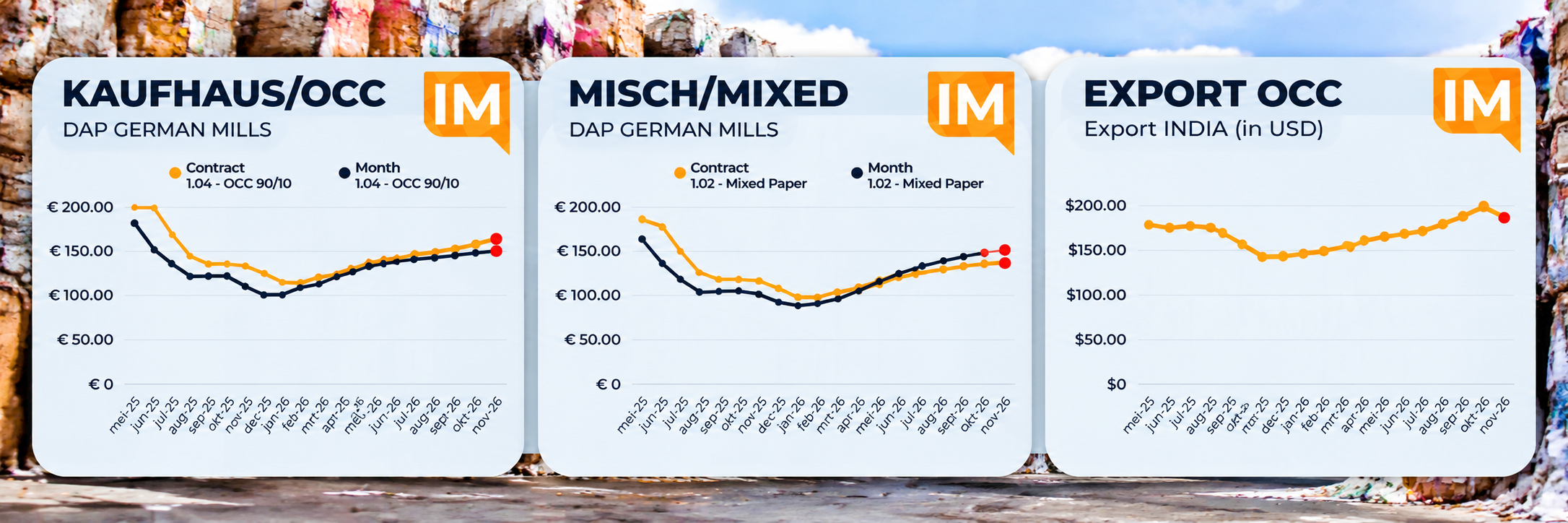
OCC continues to be a sought-after commodity, with demand showing little sign of slowing down. Saica has once again increased its purchasing prices in France by €10 per ton, bringing the total increase since early October to €30 per ton. Interestingly, the company had lowered its prices in August, a move that appears to have done little to cool the market.
Export demand is also picking up strongly again. The main limiting factor, however, remains the availability of space on container vessels. Demand is certainly there, but getting the material on board is another matter. Dutch and international exporters have taken position.
Meanwhile, German paper mills are attempting to keep prices stable in November. Whether they will succeed remains to be seen. With demand as firm as it is, holding the line may prove rather difficult.
Mixed Paper
Over the past few months, several municipal recovered-paper tenders in Germany have been concluded. Among the more notable were Mönchengladbach and Hamburg, involving substantial volumes of recovered paper.
In our view, bidding levels were once again remarkably high, and some of the winning bidders came as quite a surprise. Apparently, securing long-term volumes remains a priority, even at ambitious price levels.
Meanwhile, mixed-paper prices continue to trade just below OCC, with occasional exceptions on the upside. These higher levels, however, are mainly seen in the spot market. Interestingly, contract prices for mixed paper have remained below spot prices for several months now. Could this simply be the result of relatively few tons being available outside existing contracts? If so, the spot market may be telling us more about the scarcity of freely available material than about the overall market price.
Export OCC
By mid-October, demand from India suddenly came to a halt. With Diwali approaching, Indian buyers took a step back from the market. Much like Christmas in Europe, production tends to run at full speed in the months leading up to the festive season, before slowing down as people take time off and factories reduce their output.
At the beginning of October, prices for European OCC were still around USD 205–210 per ton CNF. By the end of the month, however, levels had dropped sharply to USD 185–190 per ton. At these levels, very few deals were concluded from Europe, as domestic purchasing prices simply did not allow exporters to compete. So far, there has been little sign of a meaningful rebound, with Indian prices appearing to have settled around USD 185–195 per ton for European material.
Elsewhere in Asia, price levels are hovering around USD 175–185 per ton CNF, although considerably lower ocean freight rates make these destinations more attractive. Freight rates to Malaysia, for example, are currently around USD 10 per ton, while Indonesia is around USD 12 per ton. This translates into FAS levels of approximately €150–152 per ton in Rotterdam and Antwerp.
For now, export demand remains present, but the gap between Asian buying prices and European collection costs leaves little room for manoeuvre. The market is not short of buyers, just short of prices that make sense.
The British recovered-paper market is heading for a major transformation in 2027. Palm Paper is converting its King’s Lynn machine from newsprint to recycled containerboard, with a planned capacity of 700,000 tonnes. Meanwhile, Eren Holding’s former UPM Shotton mill is preparing to produce another 750,000 tonnes of containerboard annually.
Although some older British paper machines are likely to close, we expect these developments to increase domestic demand for recovered paper by approximately one million tonnes per year. This will significantly strengthen the UK’s domestic recovered-paper market. Large volumes of OCC and mixed paper that previously found their way to continental Europe and Asia will increasingly be consumed at home. British exporters will face stronger competition from local mills, while European and Asian buyers may have to look elsewhere for their fibre.
But there is another interesting consequence.
The UK remains one of Europe’s relatively strong newspaper markets, with substantial volumes of newspapers and other graphic paper still entering the recycling stream. Yet, with Palm’s conversion away from newsprint, domestic demand for deinking grades will decline considerably.
Ironically, while the UK becomes increasingly self-sufficient in packaging fibres, it may have to find more overseas outlets for its graphic-paper waste. The result could be a remarkable shift: a stronger domestic market for OCC and mixed paper, but greater dependence on exports for deinking grades.
In other words, Britain may soon be importing less of its own waste paper back as finished packaging, while exporting more of yesterday’s news.
With just two months to go before DIWASS becomes mandatory on 1 January 2027, uncertainty remains remarkably high. The idea is straightforward: replace paper-based Annex VII documentation with a European digital system. The implementation, however, is proving considerably less straightforward.
For traders handling hundreds or thousands of shipments every month, manually entering each transport is simply not an option. Reliable connections between existing ERP systems and DIWASS will be essential. Whether these interfaces will work smoothly from day one remains to be seen.
And then there is Europe itself. Poland and the Baltic states appear well prepared. Scandinavia seems to be taking a more relaxed approach, patiently waiting for further clarification. France is developing its own national portal, while Spain and Italy appear to be operating on a slightly more mañana timetable. In parts of southeastern Europe, we would be surprised to see a completely trouble-free introduction. And the Netherlands? Keen to comply, naturally, but equally keen not to put its trading sector at a competitive disadvantage.
One European regulation, interpreted through 27 different national realities. What could possibly go wrong?
The consequences for international traders could be substantial. Different national portals, registration requirements, software connections and the obligation to register shipments in advance will reduce flexibility and increase administrative costs. Particularly when transport arrangements change at short notice. We are not convinced DIWASS will make life easier for the recovered-paper trade. Quite possibly the opposite. Nevertheless, the rules are coming, and we intend to comply with them.
The real question is whether all European countries, authorities and software providers will be equally ready. Hopefully, by January, moving recovered paper across Europe will still be easier than moving the information about it.
LATEST UPDATE: DIWASS POSTPONED ONCE AGAIN!

Every year, around October or November, something rather predictable happens in the recovered-paper export market. Indian buyers suddenly become less interested in our offers, negotiations slow down, and getting a quick answer becomes considerably more difficult.
The reason is Diwali.
Often compared to Christmas, Diwali is one of India’s most important celebrations. Known as the Festival of Lights, it symbolises the victory of light over darkness, good over evil and knowledge over ignorance. Families decorate their homes with lights, exchange gifts and sweets, and celebrate together. For many, it also represents prosperity, new beginnings and a fresh start in business.
Much like Christmas in Europe, production and commercial activity tend to peak in the months leading up to the festivities, before slowing down as people take time off. And perhaps that is what makes traditions so important, wherever we come from. Whether it is Diwali in India, Christmas in Europe or countless other celebrations around the world, we all seem to share the same need to occasionally escape the daily routine. To put work aside, reconnect with family and friends, and remind ourselves that life is about more than deadlines, responsibilities and the next business deal.
Different cultures, different traditions, but remarkably similar human needs. This year, Diwali falls on 8 November. We wish all our Indian customers, suppliers and friends a happy and prosperous Diwali. And once the celebrations are over, we look forward to hearing from you again. Preferably with a few more purchase orders.
 Deutsch
 Nederlands
 English