
Last month, Impress came back with a vengeance. Perhaps with a little too much vengeance, because a few editorial mistakes managed to sneak in as well.
Our apologies to the sharp-eyed readers who spotted them. But then again, it’s a newsletter — not the Financial Times.
The sun is shining, recovered paper is flowing, and somehow, together, we’ll all be fine.
Welcome to October.
Impress is back with a correction.
OCC / Cardboard
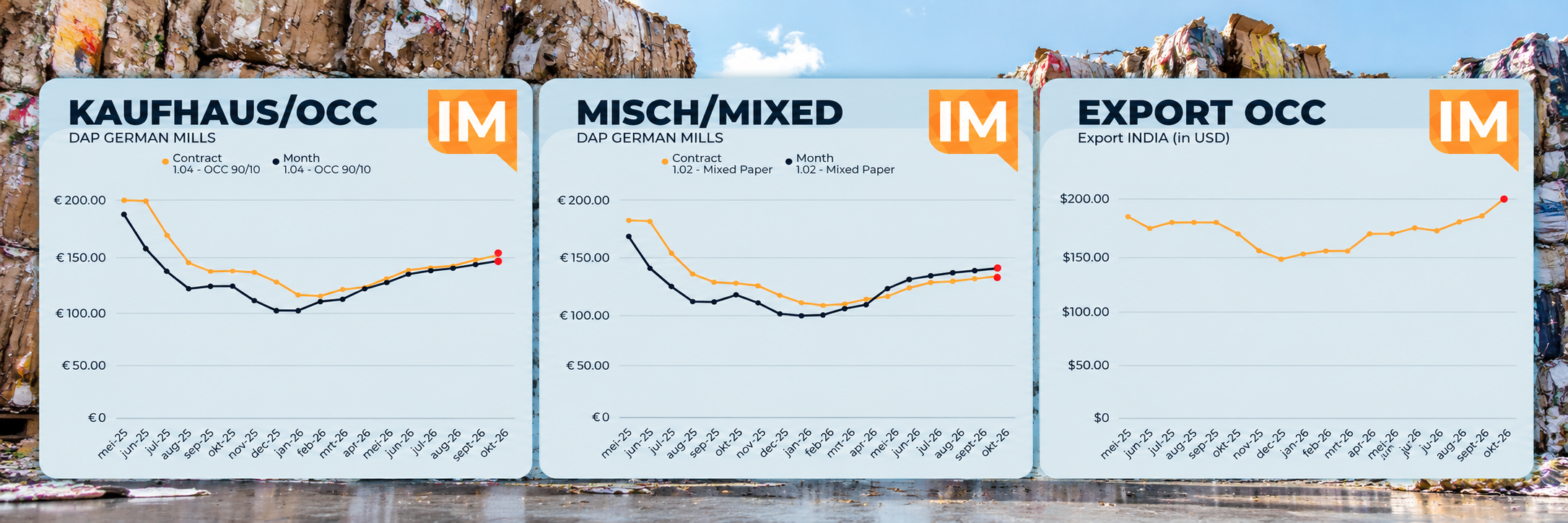
Our previous market report certainly stirred things up. Unfortunately, we managed to trip over our own opening paragraph before the report had even properly started. The picture we painted was said to be unrealistic and prompted quite a few questions. Fair enough: the figures in our introduction were incorrect. The quoted €140–150 “EXW” should have read “DAP”. Many industry professionals spotted this immediately, while others viewed the discrepancy with greater concern. The spot rates of €170–180 per tonne DAP for volumes sourced outside a mill’s usual catchment area also failed to match the wording on our website. That range should have been €165–175 per tonne. We still stand by those figures. So yes, we got a few things wrong and were duly dragged over the coals for it. No complaints: if you dish it out, you should be able to take it too. We must also admit that the market has been less volatile on the upside than expected, although demand for OCC remains healthy.
For October, the price of OCC is expected to edge up again to €140–150 per tonne DAP mill for monthly tonnages in Germany. The EUWID contract price for OCC stood at €140–150 per tonne in September and, as forecast, is expected to increase by €4–8 per tonne to €145–155.
Pressure is also building elsewhere in Europe. In France, Saica has just announced a €20 per tonne increase for OCC, as mills increasingly find themselves competing with strong export demand to Asia as well as buyers from other EU countries. This is likely to put further upward pressure on an already tightening market.
If the market continues along this path, November will most likely bring the highest OCC price level of the year.
Spot rates deserve a little more explanation, because they are not one fixed number with a neat label attached. For October, we see a realistic range of €155–175 per tonne DAP mill. Where a deal lands within that range depends heavily on the buyer’s location: a mill close to the available tonnes may secure the lower end, while a buyer sourcing outside its usual region can quickly move towards the upper end once distance, diesel, tolls and labour join the negotiation. Freight, as ever, insists on having the final word. In Belgium or the Netherlands, for example, a mill might buy at around €125 per tonne EXW in the Benelux and add approximately €35 per tonne for transport. The chosen delivery basis matters too: “spot” describes the temporary nature of the deal, not the Incoterm, so a spot agreement may just as well be concluded EXW as DAP.
For clarity, monthly prices apply to regular tonnages whose price is renegotiated each month. Contract prices cover regular monthly deliveries under an underlying agreement—often linked to an index—without monthly price negotiations. Spot prices, by contrast, are temporary agreements for a specific tonnage and period, generally used to cover shortfalls and often sourced outside the buyer’s usual region.
Mixed Paper
Prices paid for mixed paper varied widely in September. Based on the transactions known to us, delivered mill prices ranged from €120 to €150 per tonne. To put the monthly figures into context, standard offtake was generally priced at €125–135 per tonne. A handful of buyers, however, faced short-term shortages and paid €145–150 per tonne. Their quality requirements were also higher—which, for once, makes the higher price slightly less mysterious.
We expect an equally mixed picture in October. “Normal” tonnes should trade at €130–140 per tonne delivered mill, with occasional dips to €125 and sporadic peaks of up to €150.
EUWID prices for grade 1.02 mixed paper were around €125–135 per tonne in September and are expected to rise only very slightly in October. Once again, the contract price for mixed paper will, on average, remain below the market price—even if the gap is only marginal.
Export OCC
Price levels in the Far East are crawling upwards at a snail’s pace—slowly, but at least in a direction. At the end of august, the level in India was around USD 175 per tonne CNF main ports. By the end of last month, it had risen to USD 190 per tonne for 95/5 OCC from the Benelux and France. Spanish and Greek tonnes traded slightly lower, although deals above USD 190 per tonne have certainly also been concluded for Spanish and Greek material in recent days.
The main drawback of exports remains the sheer number of variables that have to be factored in. Right now, sea-container availability is limited and freight rates have been rising for two months. In July and August, some very attractive rates were still available for a number of Indian ports, but those have since disappeared. On average, a 40-foot container from Antwerp or Rotterdam to India now costs USD 250 more than it did in August. Apparently, even containers have discovered inflation.
We nevertheless expect a further modest improvement in OCC prices in India, supported by rising European prices, slightly higher freight rates and the continued lack of exports from the Middle East to India. We expect 95/5 OCC to settle at USD 200–205 per tonne. This translates into an FAS price of approximately €145–147 per tonne in the ports of Antwerp, Rotterdam and Hamburg for European 95/5 OCC. The material we produce is more commonly 90/10, which trades at approximately €5 per tonne below the 95/5 grade. Breaking through the USD 200 barrier would not exactly be welcome news for Indian importers. At the same time, local collection prices are also moving higher.
The future paper market will not be defined by one simple trend. It will be shaped by a difficult combination of consolidation, declining demand in some grades, growth in others, high energy and investment costs, stricter regulation and an increasingly strategic battle for fibre. Europe is likely to have fewer paper mills, but the mills that remain will generally be larger, more specialised and more selective about what they produce. Production may become increasingly concentrated in countries where scale, energy supply, infrastructure, raw-material availability and regulation create the most favourable conditions. The industry will not simply become smaller; it will become more concentrated, more capital-intensive and considerably less forgiving.
The range of paper grades is also expected to narrow. Mills will focus increasingly on larger and more efficient production runs, leaving less room for niche grades and small-volume specialities. Packaging papers still have some growth ahead of them, supported by changing consumption patterns and the continuing search for fibre-based alternatives. Graphic papers, however, are likely to decline further, and certain board grades will also come under pressure as demand changes and older or less competitive machines disappear.
This consolidation will have a direct impact on the recovered-paper trade. Larger mills with greater capacities will need substantial and reliable fibre flows, which should increase the volume of recovered paper traded across regions and borders. At the same time, independent traders will face tougher competition from increasingly large and powerful buyers. That applies to us as well. Size may be on the buyers’ side, but independent traders can still compete through flexibility, market knowledge, fast decision-making and the ability to solve problems that do not fit neatly into a procurement spreadsheet. In tomorrow’s market, know-how and adaptability will not be pleasant extras; they will be essential.
The availability of recovered fibre may become just as important as demand for finished paper. Collection volumes of graphic paper are already under pressure as households and offices use less printed material, while demand for packaging grades creates a different and often lower-quality fibre mix. Mills will therefore compete not only for tonnes, but for consistent composition, low contamination and predictable moisture levels. Better sorting technology can recover more usable fibre, but it cannot create fibres that are no longer entering the collection system. In some regions, scarcity may become structural rather than seasonal.
This development will also force a major change among fibre-processing industries that have long relied on graphic recovered-paper grades such as confidential office records, book-production waste and other printing residues. Producers of egg cartons, moulded-fibre packaging and insulation materials, as well as certain tissue manufacturers, will increasingly have to compete for a shrinking pool of these grades or redesign their processes around alternative raw materials. Substitution will not always be straightforward: packaging-based recovered paper often has a different fibre composition, contains more contaminants and may not deliver the same strength, softness, colour or processing behaviour. The disappearance of graphic print will therefore affect not only graphic-paper mills, but a much wider group of manufacturers that have quietly depended on its clean and valuable secondary fibres for decades.
Legislation will raise the bar further. Changing rules on waste status, shipments, traceability, quality and sustainability will demand greater professionalism from collectors, traders, transporters and mills alike. That is not necessarily a bad development: clearer standards should reward companies that understand their material, document their flows and keep their compliance in order. Those who do not have their house in order may find that the future paper market has very little room left for improvisation.
The next chapter will not be for the biggest alone, but for those strong, smart and adaptable enough to survive.
Everyone is allowed to know that I was raised in a fairly left-wing environment. Somehow, despite this ideological marinade, I still became an entrepreneur. Does that mean I am still left-wing? Many people who know me would probably say no. And, annoyingly, they may have a point.
As an entrepreneur, I have definitely moved somewhat to the right. I like lower taxes, less bureaucracy and governments that occasionally remember that companies need to make money before there is anything available to tax. But as a person, I still consider myself quite left-wing. Apparently, it is possible to want both social responsibility and fewer forms to fill in.
Recently, I read through some of the main positions of “our” Dutch version of the AfD: Forum voor Democratie (FVD). And this is where life becomes inconvenient, because there are actually points in there that I can understand: a smaller government, better protection of domestic businesses, a justice system that works properly and lower taxes.
Then you continue reading. And yes… there are also quite a few things where I get off the train immediately. You can probably guess which ones.
By the way, I once had a brief relationship with a prominent FVD figure. Naturally, the moment I discovered the political connection, I immediately ended it. No, that is complete bullshit.
People are allowed to have different opinions. Life would be extremely boring if we all voted for the same party, drove the same car and agreed on everything. As long as we respect each other, don’t dehumanise other people and don’t turn radical ideas into harmful actions, I can live surprisingly well with political disagreement.
Which brings me to Germany.
We do a lot of business there, and the rise of the AfD worries me. Not because every AfD voter is suddenly an extremist — that would be far too easy — but because the party is benefiting from something that is very real: dissatisfaction.
And I can understand some of that dissatisfaction. Germany has spent decades dealing with its history in a way few other countries have had to. That history must never be forgotten or minimised. But I also think there has sometimes been too little room for ordinary Germans to discuss national identity, pride and frustration without immediately becoming nervous about where such a conversation might lead.
When people feel that certain subjects cannot be discussed, those subjects do not disappear. They usually come back through a different door — and sometimes wearing a much more radical coat.
At the same time, Germany has been one of the great financial and industrial engines of the European Union. Germans have contributed enormously to European prosperity. Meanwhile, economies such as Poland and Romania have developed rapidly — which is, fundamentally, one of the great successes of the European project.
But I can also understand why a German factory worker watching his own industry struggle may occasionally think: Hang on. How exactly is this working out for us?
If people start believing that solidarity mainly means paying while somebody else is progressing, solidarity becomes harder to sell. And once prosperity and security start feeling threatened, loyalty between countries becomes more fragile.
So my message to Germany is actually quite simple:
Take back control — but take back control of the right things.
Focus on what Germany has always been exceptionally good at: making high-quality products, engineering things properly and building an industrial economy that the rest of Europe actually needs.
And to German — and European — politicians: protect the European industry.
That should not be an AfD position. It should be common sense.
A strong industrial base, competitive energy prices, manageable bureaucracy and a functioning European market are not left-wing or right-wing ideas. They are prerequisites for having enough prosperity to argue about left and right in the first place.
Because when people are reasonably satisfied, they have much less need to find somebody to blame.
The immigrants, the Chinese, the Poles, Brussels, or, worst of all, the Dutch.
And yes, complaints about immigration tend to become louder when wider dissatisfaction grows. That does not mean immigration policy cannot be discussed critically. Of course it can. But blaming every economic, social and industrial problem on one group is wonderfully convenient — and usually wonderfully inaccurate.
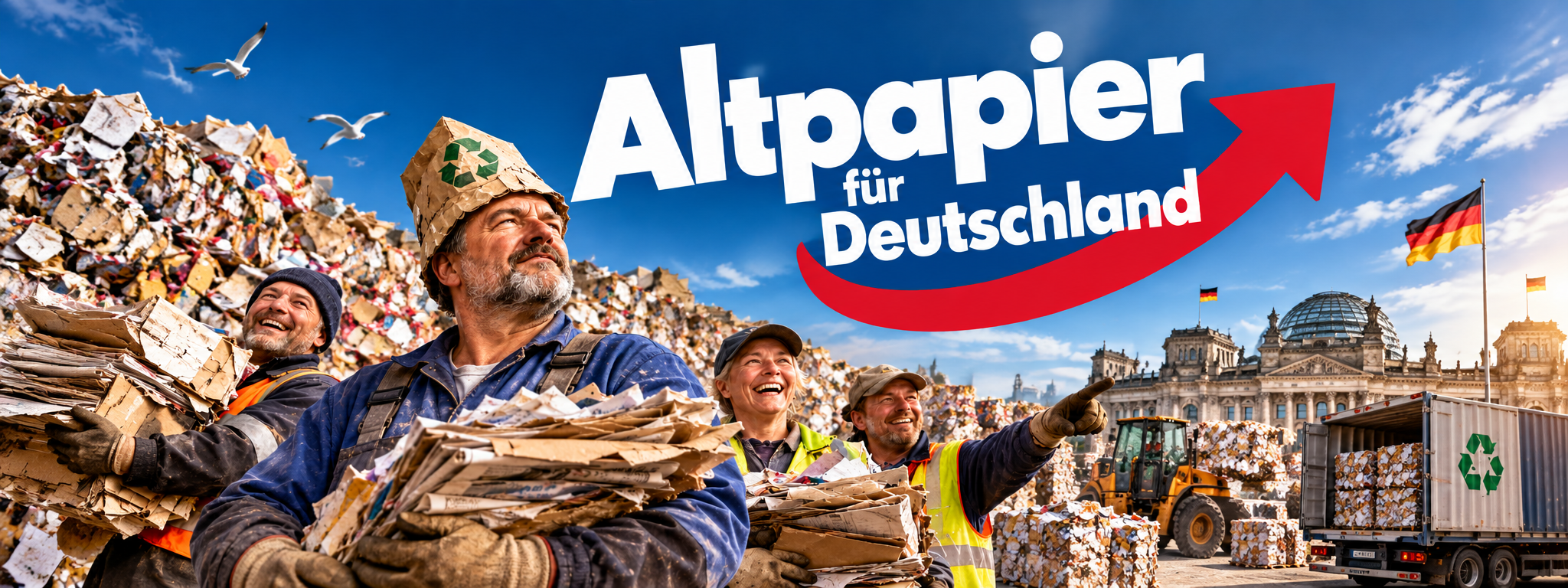
So perhaps Germany does need a new AfD. Just not Alternative für Deutschland.
At Imtrade, we propose: Altpapier für Deutschland.
Our programme is refreshingly simple.
No deportations.
No referendums.
No geopolitical revolution.
Just good-quality recovered paper, delivered at a competitive price and preferably paid within the agreed payment terms.
We believe this could unite the country.
Because a German customer with a full warehouse, a running paper machine and a decent raw-material price has considerably less time to complain about immigrants, Brussels, Poland or those irritating Dutch traders.
And after the reactions to our last newsletter, we know one thing for certain:
Keeping Germans from complaining about the Dutch may be our most ambitious political programme yet.
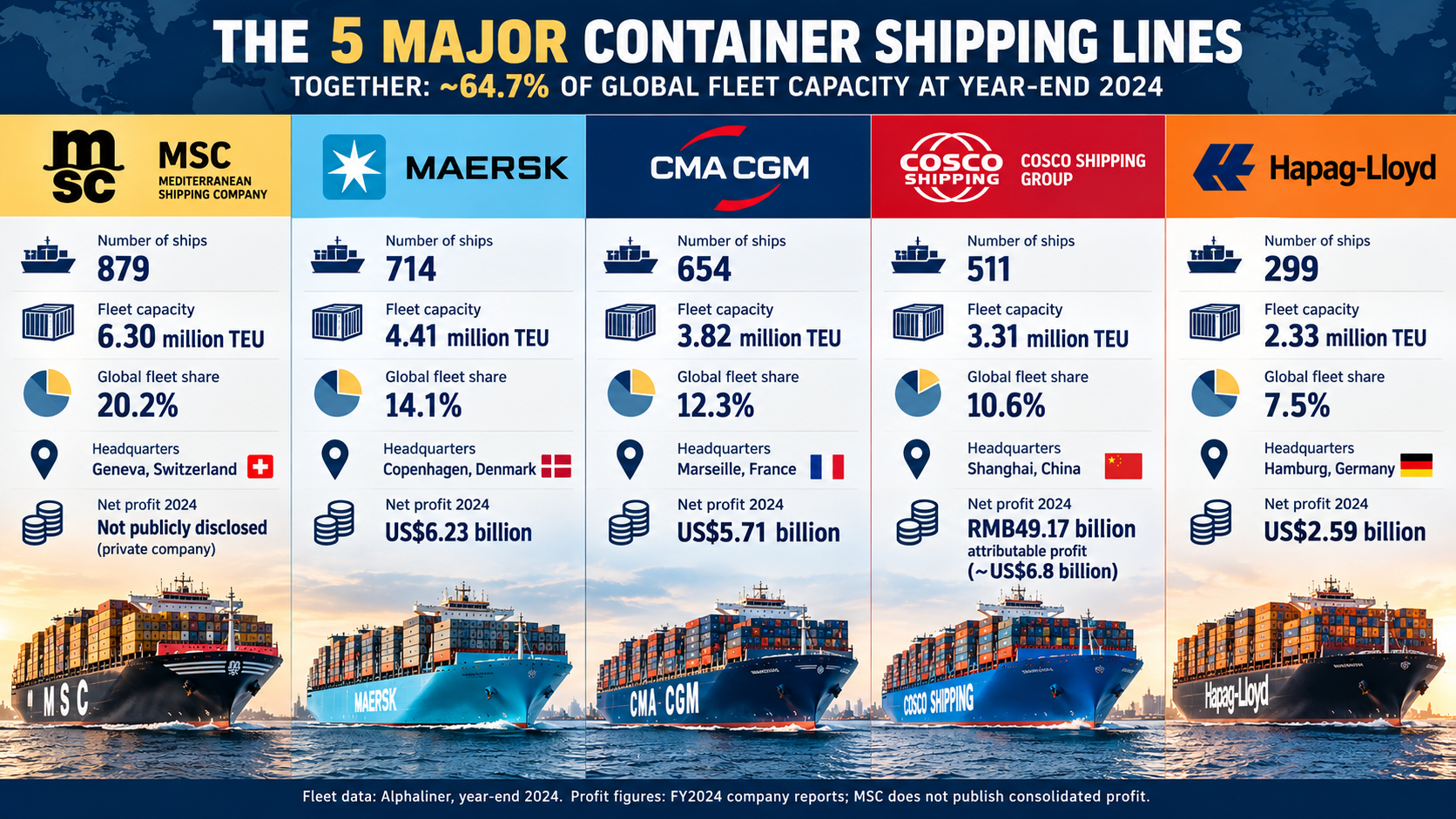
There are still many names painted on containers, but only a few independent networks behind them. The five largest container carriers now control roughly two-thirds of global capacity. That may not legally be a monopoly, but for an ordinary shipper it can feel close. These companies are too large to argue with, yet often too large to offer reliable personal service. You can make a booking with a global company, receive an automatic confirmation and still find that nobody can tell you where your container will be next Tuesday.
The imbalance is clearest in the terms and conditions. They read less like an agreement between two business partners and more like a long list of what the shipping line may do, what the customer must pay and what the shipping line is not responsible for. A vessel may be delayed, a port skipped, a route changed, or a booking moved or cancelled. The arrival date may change again and again. Meanwhile, the shipper is expected to stay flexible, available and able to pay. The contract mainly makes one thing clear: who will receive the invoice.
The Strait of Hormuz crisis showed this imbalance at its worst. When the conflict involving the United States, Israel and Iran made the strait unsafe and almost impossible to use, vessels stopped, cargo was trapped and the ports of Jebel Ali and Khalifa could no longer work as normal gateways. New collection and transfer points had to be found. Ports such as Salalah and Colombo took on new roles in Asia, while Wilhelmshaven became more important in Maersk’s European network. Nobody can blame a carrier for refusing to sail through a war zone. The safety of crews and vessels must come first.
The rerouting itself was not the problem. The problem was what came next. Emergency action led to emergency charges, extra handling created extra costs and almost every result was passed on to the shipper. Costs from war risks, longer routes, busy ports and network changes can be real. But when the carrier sets the charge, calculates it, applies it and decides when it ends, there is little room to negotiate. How can you negotiate with a supplier that controls the space, schedule, terms and complaints process? In practice, you cannot.
The same pattern now appears in less serious situations. Arrival times change as a matter of routine. Bookings are moved, changed or cancelled with little explanation. Transit times have become very rough estimates. Customer-service teams can record a complaint, but they often cannot solve it. Local offices sometimes seem to know little more than the online tracking page. To be fair, container transport is often surprisingly cheap for the distance and work involved. But a low price does not excuse poor customer service. Nor does it explain why getting a useful answer to a fair complaint can feel harder than moving the cargo itself.
For commodity traders, this is more than annoying paperwork. Raw-material markets depend on timing, volume and reliable planning. A paper mill cannot run on a promise that a container may arrive sometime next month. A recycler cannot keep unlimited tonnes waiting because a booking has been moved. A buyer cannot work out a fair delivered price when freight costs, extra charges and transit times can all change after the deal is made. The result is more stock kept aside for safety, more money tied up during transport, higher insurance and storage costs, wider trading margins and a greater risk that useful material remains in the wrong place.
In the end, this uncertainty harms world trade. It benefits large companies that can promise huge volumes, agree yearly contracts and spread their risk across several routes. Smaller exporters, importers and traders pay more, wait longer and have less influence when something goes wrong. Some trades simply stop making sense. Goods are then bought closer to home, not because the local choice is better or greener, but because ocean transport has become too unreliable. Globalisation does not end with one big announcement. It becomes a little less efficient each time a booking disappears and nobody takes responsibility.
Shipping lines provide an essential service. They run very complex networks and face risks that no single shipper could handle alone. Their size is what makes global container trade possible. But size should bring responsibility as well as power. Customers do not expect every vessel to arrive on time or every crisis to be paid for by the carrier. They do expect clear charges, realistic transit information, reliable bookings and contact with someone who can answer a question and make a decision. That is not too much to ask. In most industries, it is simply called service.
 Nederlands
  English
  Deutsch